 ChinaBuddy
China's 240-Hour Visa-Free Transit: 57 Countries, 65 Ports, 10 Days
Understand China’s visa-free transit rules, eligible routes and ports, permitted areas, and common itinerary mistakes.
IN THIS GUIDE
Ordinary passports · Applies to nationals of 57 countries transiting to a third country or region
The 240-hour visa-free transit policy is China's widest-reaching entry scheme by nationality: it covers the United States, the United Kingdom, Japan, South Korea, Australia, Canada, Brazil and most of Europe. It is also the scheme with the most conditions attached, because it is a transit facility rather than a general visa waiver.
This page covers the eligibility rules, the 57-country list, all 65 eligible ports and their permitted areas, the separate 24-hour scheme, and the route patterns that fail at the border.
New to the topic? Start with the pillar guide to China's visa-free schemes.
What the scheme actually allows
Ask Buddy ↗| Requirement | Detail |
|---|---|
| Nationality | One of the 57 countries listed below |
| Passport | Ordinary passport |
| Route | China must be a stop between two different countries/regions, and you must be travelling on to a third country or region |
| Ticket | Onward air, sea or rail ticket with a confirmed seat and confirmed departure date |
| Entry port | One of the 65 designated ports in 24 provinces, autonomous regions and municipalities |
| Stay | No more than 240 hours (10 days), counted from 00:00 the day after entry |
| Area | Only the permitted areas of those 24 provinces; travel between them is allowed, leaving them is not |
| Activities | Tourism, business, visits, family reunions. Work, study and news reporting require prior approval and the appropriate visa |
Two details decide most cases. First, "third country or region" is strict: flying London → Shanghai → London does not qualify, while London → Shanghai → Tokyo does. Second, the permitted area is a real boundary. A side trip to a province outside the list is an overstay of the permitted area even if your 240 hours have not run out.

The 57 eligible countries
Ask Buddy ↗Source: National Immigration Administration, Visa-Free Transit Policies, 20 August 2026, updated after Kyrgyzstan and Vietnam were added (Announcement No. 4 of 2026).
| Region | Countries |
|---|---|
| Europe (40) | Albania, Austria, Belarus, Belgium, Bosnia and Herzegovina, Bulgaria, Croatia, Cyprus, Czech Republic, Denmark, Estonia, Finland, France, Germany, Greece, Hungary, Iceland, Ireland, Italy, Latvia, Lithuania, Luxembourg, Malta, Monaco, Montenegro, Netherlands, North Macedonia, Norway, Poland, Portugal, Romania, Russia, Serbia, Slovakia, Slovenia, Spain, Sweden, Switzerland, Ukraine, United Kingdom |
| Asia (9) | Brunei, Indonesia, Japan, Kyrgyzstan, Qatar, Singapore, South Korea, United Arab Emirates, Vietnam |
| North America (2) | Canada, United States |
| South America (4) | Argentina, Brazil, Chile, Mexico |
| Oceania (2) | Australia, New Zealand |
Note the gaps: India, the Philippines, Thailand, Malaysia, South Africa and most of Africa, the Middle East and Central Asia are not on this list. Thai, Malaysian and Singaporean nationals are more likely to use a mutual exemption agreement, while Philippine and Indian nationals generally need a visa.
For the full nationality picture, including the 50 countries with 30-day unilateral exemption:
→ China Visa-Free Entry: the full scheme comparison and country list
The 65 ports and their permitted areas
Ask Buddy ↗You may enter at any of these ports and stay within the listed area. Travel between permitted areas in the 24 provinces is allowed within your 240 hours; travel outside them is not.
| Province / municipality | Count | Ports | Permitted stay area |
|---|---|---|---|
| Beijing | 2 | Beijing Capital Int'l Airport; Beijing Daxing Int'l Airport | Beijing Municipality |
| Tianjin | 2 | Tianjin Binhai Int'l Airport; Tianjin Port (passenger) | Tianjin Municipality |
| Hebei | 2 | Shijiazhuang Zhengding Int'l Airport; Qinhuangdao Port (passenger) | Hebei Province |
| Liaoning | 3 | Shenyang Taoxian Int'l Airport; Dalian Zhoushuizi Int'l Airport; Dalian Port (passenger) | Liaoning Province |
| Shanghai | 3 | Shanghai Hongqiao Int'l Airport; Shanghai Pudong Int'l Airport; Shanghai Port (passenger) | Shanghai Municipality |
| Jiangsu | 4 | Nanjing Lukou Int'l Airport; Suzhou Sunan Shuofang Int'l Airport; Yangzhou Taizhou Int'l Airport; Lianyungang Port (passenger) | Jiangsu Province |
| Zhejiang | 6 | Hangzhou Xiaoshan Int'l Airport; Ningbo Lishe Int'l Airport; Wenzhou Longwan Int'l Airport; Yiwu Airport; Wenzhou Port (passenger); Zhoushan Port (passenger) | Zhejiang Province |
| Anhui | 2 | Hefei Xinqiao Int'l Airport; Huangshan Tunxi Int'l Airport | Anhui Province |
| Fujian | 5 | Fuzhou Changle Int'l Airport; Xiamen Gaoqi Int'l Airport; Quanzhou Jinjiang Int'l Airport; Wuyishan Airport; Xiamen Port (passenger) | Fujian Province |
| Shandong | 5 | Jinan Yaoqiang Int'l Airport; Qingdao Jiaodong Int'l Airport; Yantai Penglai Int'l Airport; Weihai Dashuipo Int'l Airport; Qingdao Port (passenger) | Shandong Province |
| Henan | 1 | Zhengzhou Xinzheng Int'l Airport | Henan Province |
| Hubei | 1 | Wuhan Tianhe Int'l Airport | Hubei Province |
| Hunan | 2 | Changsha Huanghua Int'l Airport; Zhangjiajie Hehua Int'l Airport | Hunan Province |
| Guangdong | 10 | Guangzhou Baiyun Int'l Airport; Shenzhen Bao'an Int'l Airport; Jieyang Chaoshan Int'l Airport; Nansha Port (passenger); Shekou Port (passenger); Guangzhou Pazhou Ferry Terminal; Zhongshan Port (passenger); Hengqin Port; Hong Kong–Zhuhai–Macao Bridge Port; West Kowloon Station of the Guangzhou–Shenzhen–Hong Kong Express Rail Link | Guangdong Province (exits available at all open ports across the province) |
| Hainan | 2 | Haikou Meilan Int'l Airport; Sanya Phoenix Int'l Airport | Hainan Province |
| Chongqing | 1 | Chongqing Jiangbei Int'l Airport | Chongqing Municipality |
| Guizhou | 1 | Guiyang Longdongbao Int'l Airport | Guizhou Province |
| Shaanxi | 1 | Xi'an Xianyang Int'l Airport | Shaanxi Province |
| Shanxi | 1 | Taiyuan Wusu Int'l Airport | Taiyuan and Datong |
| Heilongjiang | 1 | Harbin Taiping Int'l Airport | Harbin |
| Jiangxi | 1 | Nanchang Changbei Int'l Airport | Nanchang and Jingdezhen |
| Guangxi | 4 | Nanning Wuxu Int'l Airport; Guilin Liangjiang Int'l Airport; Beihai Fucheng Airport; Beihai Port (passenger) | 12 cities: Nanning, Liuzhou, Guilin, Wuzhou, Beihai, Fangchenggang, Qinzhou, Guigang, Yulin, Hezhou, Hechi, Laibin |
| Sichuan | 2 | Chengdu Shuangliu Int'l Airport; Chengdu Tianfu Int'l Airport | 11 cities: Chengdu, Zigong, Luzhou, Deyang, Suining, Neijiang, Leshan, Yibin, Ya'an, Meishan, Ziyang |
| Yunnan | 3 | Kunming Changshui Int'l Airport; Lijiang Sanyi Int'l Airport; Mohan Railway Port | 9 cities and prefectures: Kunming, Yuxi, Chuxiong, Honghe, Wenshan, Pu'er, Xishuangbanna, Dali, Lijiang |
What this means in practice. A Beijing–Shanghai–Hangzhou itinerary works: all three sit in permitted areas. A Beijing–Shanghai–Hong Kong itinerary needs care, because Hong Kong is a separate region for transit purposes and the mainland leg must still end inside the permitted area. A Shanghai–Xi'an–Beijing route works (Shaanxi is listed); Shanghai–Lhasa does not (Tibet is not among the 24).
The 24-hour scheme: all countries, all open ports
Ask Buddy ↗Separate from the 240-hour policy, China applies a 24-hour visa-free transit facility to nationals of all countries at all open ports:
- you must hold a valid international travel document and an onward air, ship or train ticket with a confirmed seat;
- you must be travelling on to a third country or region;
- you may not leave the restricted area of the port;
- if you genuinely need to leave that area (for example, to change airports or stay overnight), you must first obtain a temporary entry permit from the immigration inspection authority at that port.
The 24-hour scheme is the fallback when your nationality is not on the 57-country list but your connection is short and airside. It is not a substitute for the 240-hour scheme if you want to leave the airport.
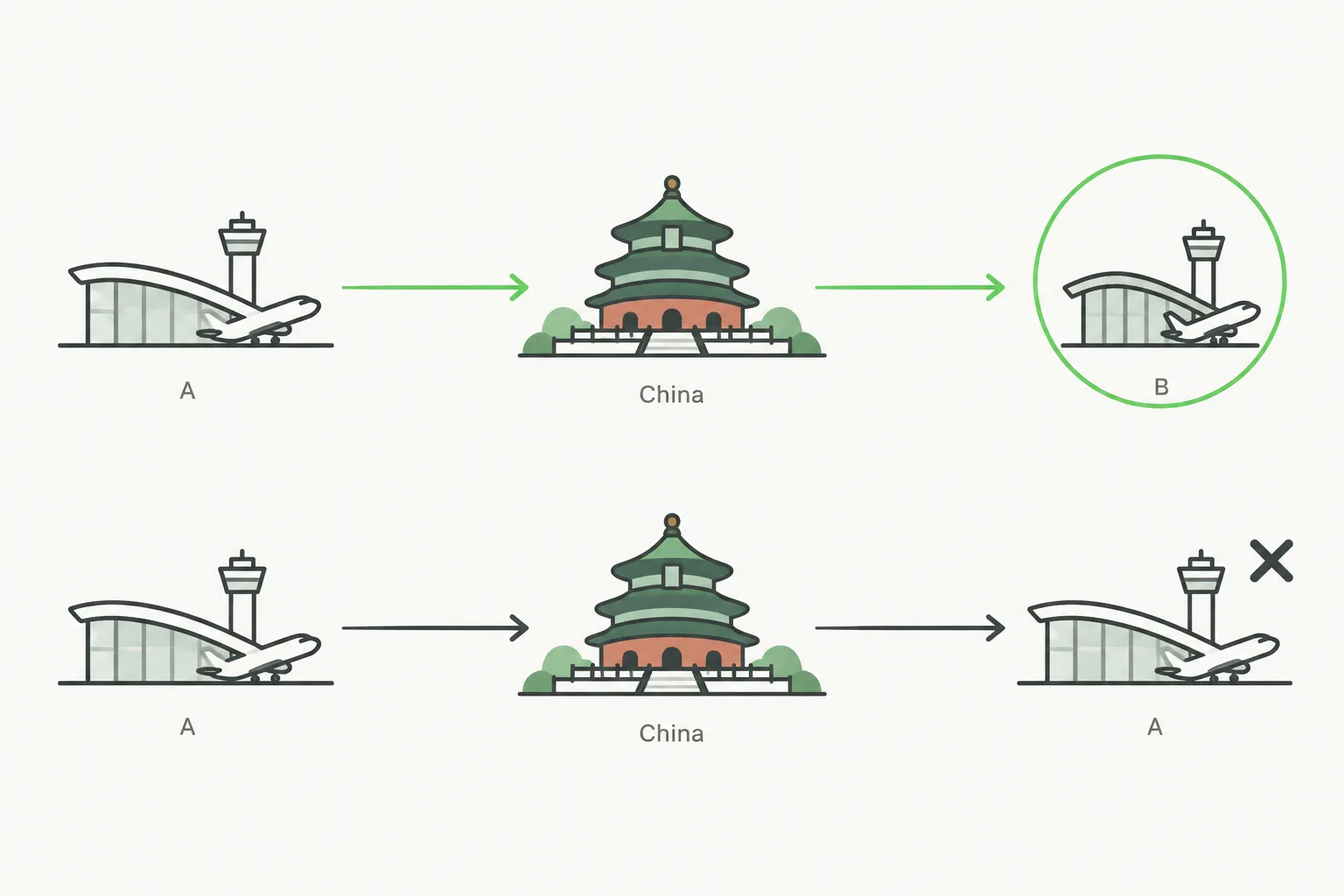
Route structure, illustrated: A → China → B shows onward travel to a different country or region; A → China → A does not satisfy that transit condition. Nationality, confirmed tickets, designated ports and permitted areas must also qualify.
Routes and plans that fail
Ask Buddy ↗| Plan | Why it fails |
|---|---|
| London → Shanghai → London | The return leg is your origin, not a third country |
| London → Beijing → Shanghai → London | Still no third country; a domestic leg does not count |
| Paris → Guangzhou → Paris, with a Hong Kong side trip | The onward ticket must leave for a third country or region, and the trip must end accordingly |
| Entering at a port that is not on the list | Only the 65 designated ports apply |
| Shanghai → Lhasa → Chengdu | Tibet is outside the permitted areas |
| Using the 10 days for paid work or a film shoot | Work, study and reporting require prior approval and a visa |
| Arriving with an onward ticket that has no confirmed seat or date | The ticket condition is explicit and checked |
Planning a compliant transit trip
Ask Buddy ↗- Fix the third country first. Book the onward leg to a country or region that is neither China nor your origin, with a confirmed seat and date.
- Choose a listed port for arrival, and check that every city on your itinerary sits in a permitted area, including day trips.
- Count backwards from 240 hours and confirm your departure falls inside it, remembering the count starts at 00:00 the day after entry. See how the days are counted.
- Register your accommodation within 24 hours if you are not staying in a hotel.
- Carry the paperwork: printed onward ticket, hotel bookings, and a screenshot of the official notice.
- Do not plan work, study or media activity inside the transit stay.
FAQ
Ask Buddy ↗Can I leave the airport on a 240-hour transit?
Yes, that is what the scheme is for, but only within the permitted areas of the 24 listed provinces and only with an onward ticket to a third country.
Do I need a visa if I only change planes in China?
If you stay airside for under 24 hours and do not leave the restricted area, no. If you want to leave the airport, you need either the 240-hour scheme (if your nationality qualifies) or a temporary entry permit for the short connection.
Can I enter China twice on one trip under the 240-hour scheme?
Each entry is assessed separately and must meet the conditions at that point. Do not build an itinerary that depends on being readmitted as a matter of course.
Does the 240-hour scheme work for a round-trip ticket that returns through China?
Only if the segment into China is followed by travel to a third country or region. Returning home through the same Chinese port is not a transit for this purpose.
Is Hong Kong or Macao a "third country or region"?
Hong Kong and Macao are separate regions for transit purposes, but the mainland leg still has to end with onward travel that satisfies the rule. If your plan hinges on this, confirm with the airline and the immigration authority at your arrival port before booking.
What if my onward flight is cancelled?
Contact the local exit-entry administration before your permitted stay expires. Do not simply stay on and assume the disruption covers you.
Sources
- NIA: Visa-Free Transit Policies (24-hour and 240-hour; 57 countries, 65 ports, 24 provinces), 20 Aug 2026. https://en.nia.gov.cn/n147418/n147463/c183412/content.html
- NIA: Announcement No. 4 of 2026: Kyrgyzstan and Vietnam added, 20 Aug 2026. https://en.nia.gov.cn/n147418/n147468/c217849/content.html
- NIA: Regional Visa-Free Entry Policies for Foreign Nationals, 20 Aug 2026. https://en.nia.gov.cn/n147418/n147463/c180637/content.html
- NIA: Online Accommodation Registration Service, 21 Sep 2026. https://en.nia.gov.cn/n147418/n147463/c237273/content.html
- Exit and Entry Administration Law of the PRC: stay conditions and penalties. https://en.nia.gov.cn/n147418/n147458/c155982/content.html
- NIA 12367 hotline: port-specific confirmation.