 ChinaBuddy
When Weather Disrupts Your China Trip: What to Check and Change
Separate weather warnings from transport status, choose a safe backup, and handle affected bookings in the right order.
IN THIS GUIDE
Check three things separately: the local warning, the transport operator's status and the destination's opening notice. If authorities instruct you to shelter, evacuate or avoid an area, follow that instruction first. When it is safe to rearrange plans, establish the affected booking's refund or change options before buying replacements.
A forecast, a warning and a cancellation answer different questions
Ask Buddy ↗A forecast helps you prepare clothing and activities. A warning identifies a hazard in a particular area and period. An airline, railway, ferry company or attraction then communicates the status of its own service.
Check the warning's place, issue time, hazard and instructions. A screenshot from yesterday or a warning for another district may not answer your situation. National weather portals and the local meteorological authority are better starting points than an unverified repost.
A service can change even when the weather looks calm where you are: the route, origin or destination may be affected. Conversely, a rain symbol in an app does not by itself prove that your train has been cancelled. Read the operator's notice and your actual order.
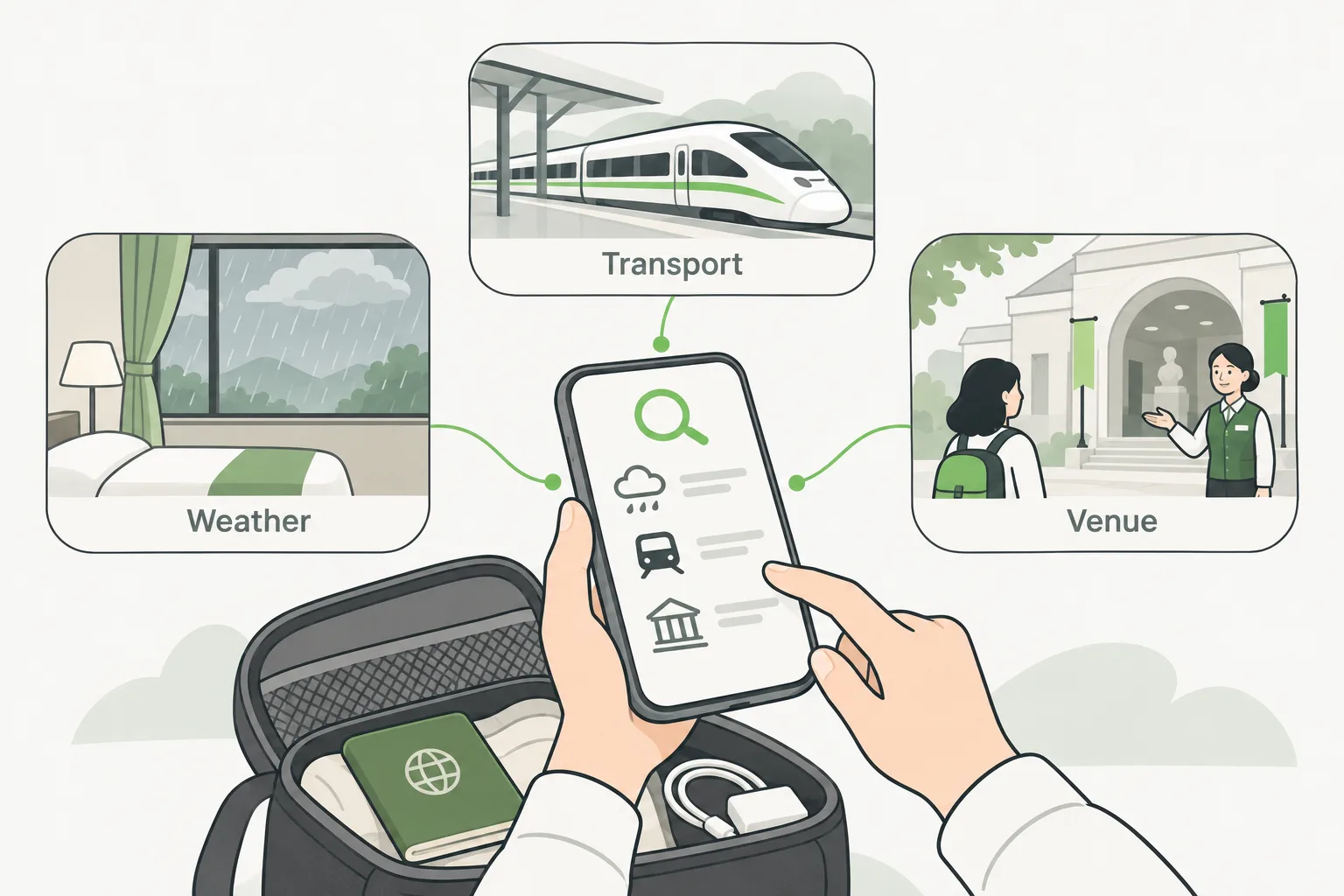
Check local warnings, the actual transport service and the venue’s opening notice separately.
Deal with an unsafe situation before the itinerary
Ask Buddy ↗During heavy rain or flooding, official emergency guidance advises avoiding low-lying areas and underground spaces that may flood. Do not enter floodwater or a flooded underpass to save a booking. Follow local directions to a safe place and seek help from staff or emergency services if needed.
For mountain, river, coastal or island outings, ask the operator about access restrictions before setting off. Do not pass a closure barrier because the first section appears usable. A mountain or coastal excursion is a different decision from a short sheltered walk near your hotel.
If told to evacuate, follow the authority or venue's arrangements promptly. If you are already in a safe place and movement is restricted, do not travel to a station merely to ask a question that can be handled by phone or through the provider.
Verify your actual departure
Ask Buddy ↗Open the issued order and check the date, train or flight number and the operating provider. Look for a direct operator notice, not just a route-search result. Save the notice with its timestamp and the order reference.
Ask 我的这班车/航班是否正常运行?如果停运/取消,应该怎样办理退改? — “Is my train/flight operating? If it is cancelled, how should I arrange a refund or change?”
If a flight remains scheduled, follow the airline's check-in instructions unless it tells you otherwise; your preferred delay estimate is not a new check-in deadline. If reaching the airport is unsafe or impossible, contact the carrier promptly and retain the relevant local notices.
For a railway cancellation, ask for the operator's disruption procedure. For a flight, ask whether an involuntary change or refund applies and whether a booking agent must handle it. Do not assume a weather event guarantees a hotel, meal or compensation from every provider.
Rebuild the trip in dependency order
Ask Buddy ↗First establish somewhere safe to stay. Then confirm the replacement transport and only afterwards adjust the bookings depending on that journey.
For example, if your evening train is cancelled, check the hotel extension and an available replacement before cancelling tomorrow's attraction. An onward ticket, hotel and tour bought separately do not automatically change together.
Read the cost and terms of the replacement, including a different arrival station or airport. Check that it is issued and confirmed. A new search result or submitted request does not settle the travel problem.
Contact the hotel, pickup provider and activity operator with the revised arrival or cancellation request. Retain replies and receipts. If you intend to claim on travel insurance, follow your policy's evidence and notification requirements; coverage depends on the policy and circumstances.
Keep a backup that is safe to reach
Ask Buddy ↗Before an exposed outing, save a nearby indoor alternative and the route back to your accommodation. The alternative also needs an opening check and, where applicable, a reservation. A museum across a flooded city is not a useful “rainy-day backup.”
Keep the hotel's Chinese address, essential contacts, identity documents, necessary medication and charging supplies accessible. Tell your companions where you are waiting and agree a specific meeting point if connectivity fails.
Recheck local instructions before resuming travel. A cancelled warning does not by itself confirm that every attraction, road or transport service has reopened.
Sources
- National Meteorological Center: current warning signals and links to hazard forecasts.
- Ministry of Emergency Management: flood-season public safety guidance, 23 June 2026.
- National Emergency Broadcasting: heavy-rain warnings and avoiding flood-prone areas.
- China Southern: check-in handling and involuntary changes during disruption.