 ChinaBuddy
Cash, ATMs and Payment Backups in China
Prepare RMB cash, use an ATM with an overseas card and recover from payment failures without relying on a single phone or account.
IN THIS GUIDE
Prepare at least two usable payment routes before travelling in China. A mobile wallet with an eligible overseas card can be convenient, while RMB cash and a separate card provide resilience when the phone, network, merchant code or issuer fails.
There is no single cash amount that suits every traveller. Consider your first transfer, meals, any unpaid hotel charges and what you would need before reaching another working payment option.
Know which payment you are trying to make
Ask Buddy ↗| Situation | First check | Backup to consider |
|---|---|---|
| Merchant QR payment fails | Merchant type, selected card, fee and in-app error | Another supported checkout method or RMB cash |
| Foreign card is declined at a terminal | Supported network, PIN and issuer authorisation | A different eligible card or cash |
| Phone is offline or out of battery | Whether you can restore connection or charge safely | Physical card where supported, or cash |
| ATM rejects the card | Network logo, issuer settings and displayed message | Another bank-operated ATM or authorised exchange outlet |
Check whether a transaction has already succeeded before paying again. A slow confirmation screen or pending card entry does not necessarily mean you should retry immediately.
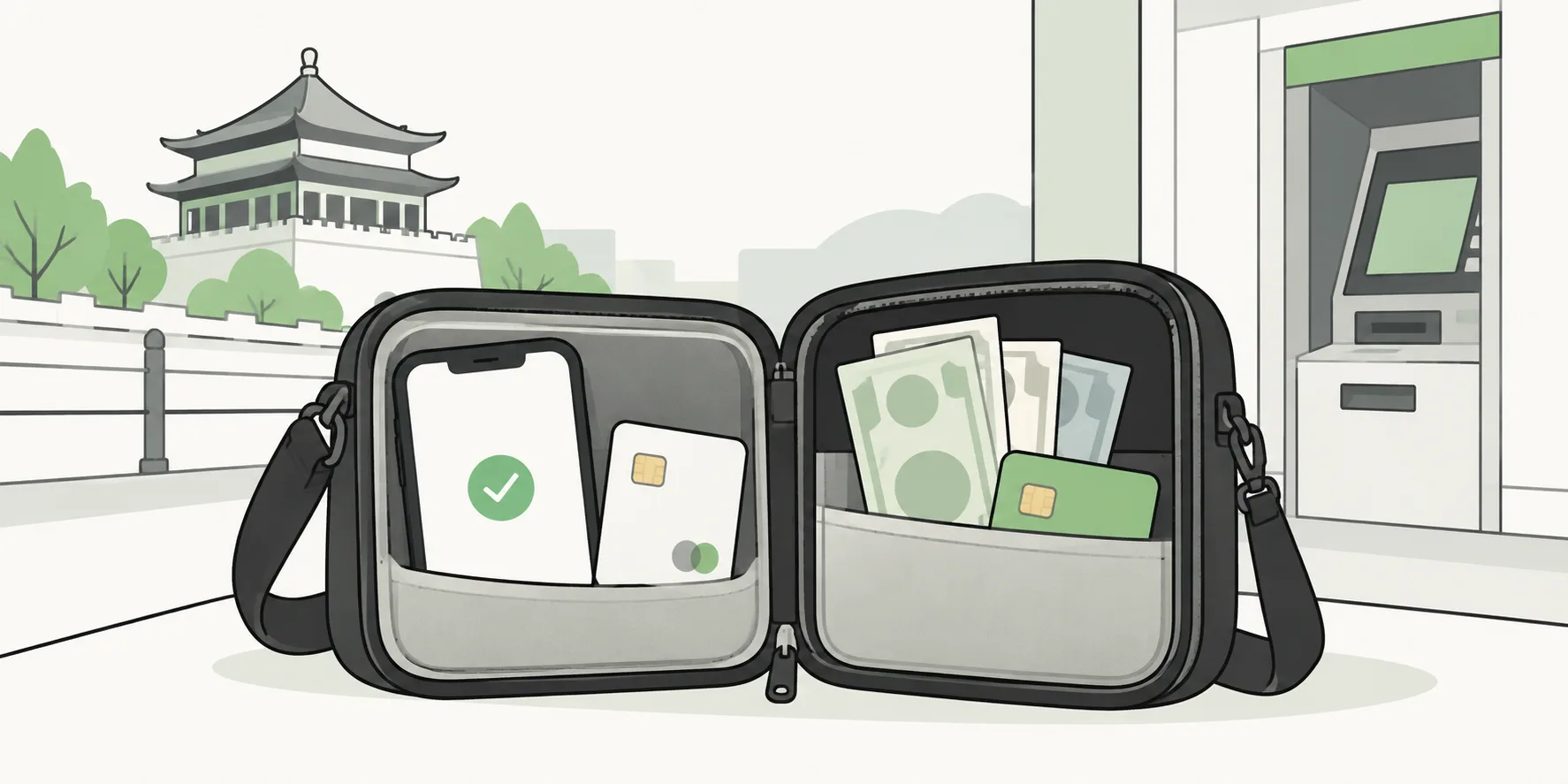
Illustrative payment backup: keep a second usable payment route separate from the phone or wallet you use most.
Withdraw RMB with an overseas card
Ask Buddy ↗Official visitor guidance explains that compatible overseas cards can withdraw RMB at ATMs displaying the relevant card-network logos. A matching logo does not override your issuer's limits, fraud checks, card settings or ATM availability.
Use a bank-operated ATM in a suitable, well-observed location. Choose the language option and read the instructions. Review the amount, any ATM fee and any offered currency-conversion terms before agreeing.
Your issuer can apply its own withdrawal and currency fees. If the ATM offers to convert the amount into your home currency, compare the displayed terms with what your issuer provides rather than treating the home-currency display as automatically cheaper.
Keep your card secure while entering the PIN, wait for the machine to complete the transaction and retrieve the card, cash and receipt. If a card is retained or cash is not delivered, use the bank's verified contact channel and record the ATM location and transaction time.
Do not accept a stranger's offer to operate the ATM using your PIN.
Exchange money through an authorised outlet
Ask Buddy ↗Banks, qualified exchange outlets and some airport facilities provide currency exchange. Check the sign, identification requirements, opening hours, accepted currencies, rate and total before proceeding. A foreign currency accepted at one outlet is not guaranteed at another.
Carry your original passport when the provider requires identification. Keep the receipt, particularly if you may need to explain a transaction or ask about exchanging remaining money later.
Avoid treating airport exchange facilities as universally available at every terminal and hour. Check the actual arrival arrangement and keep a fallback that works if the counter is closed.
Use cash practically
Ask Buddy ↗The currency for mainland day-to-day cash purchases is renminbi, usually described as RMB or yuan. Do not assume merchants will take foreign banknotes.
Ask for an itemised amount and check your change. Smaller denominations can make modest purchases easier, especially when a driver or small business has limited change. Confirm payment before a taxi journey or service begins.
Keep only part of your cash in the wallet you use frequently. Store the rest and a backup card separately, with emergency contact details that remain accessible if your phone is lost.
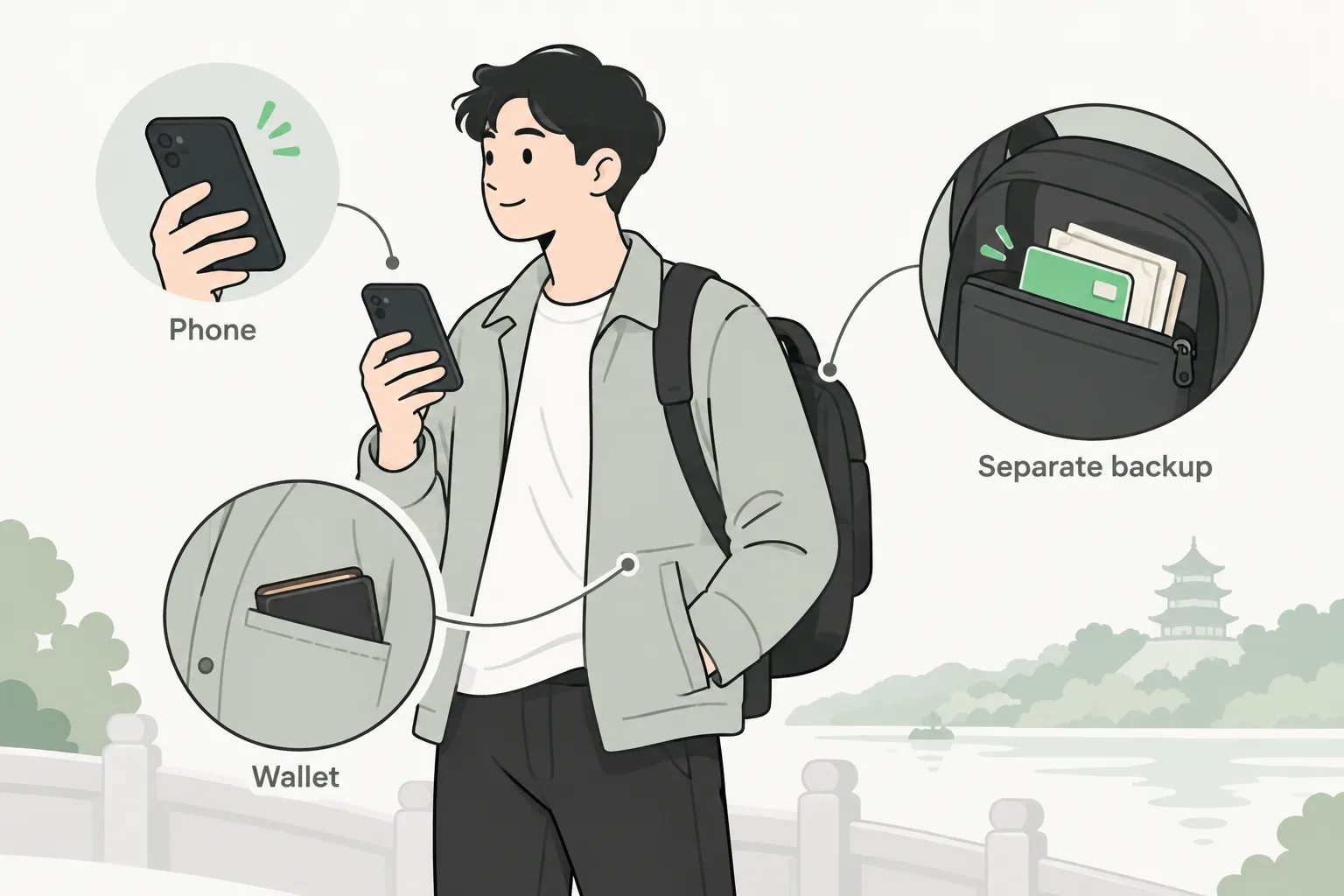
Illustrative separation: keep the phone, daily wallet and a reserve card or cash in different accessible places, so one loss does not remove every payment route.
Follow the message when a wallet payment fails
Ask Buddy ↗An overseas-card payment may fail because of the merchant's collection method, account verification, issuer controls, available funds or a network problem. These require different fixes.
Read the error, verify the selected funding card and ask whether the business has another supported merchant checkout. Follow official verification prompts if needed. Do not repeatedly submit a large payment or share one-time codes with someone promising to unlock it.
Contact your bank using its app or the official number printed on the card. Use the wallet's official support for an account or transaction issue. If two charges appear, retain both records and request assistance instead of assuming a verbal promise has reversed one.
Keep a small offline payment record
Ask Buddy ↗Save the card issuer's international contact, your insurer's assistance details and a way to identify important bookings without storing full card details or PINs in an exposed note. Check how you will receive account-verification SMS abroad.
For a lost wallet or phone, follow the loss-response guide. Restoring a payment option is only one part of protecting the affected accounts.