 ChinaBuddy
Overnight Trains in China: Choosing and Using a Sleeper Berth
Choose an overnight train by berth, arrival time and privacy needs, then prepare for boarding and the morning after.
IN THIS GUIDE
Choose a sleeper only when the issued berth, departure time and next-morning arrival fit your needs. An overnight departure does not necessarily mean a bed, and a berth booking does not necessarily mean a private compartment. Compare it with a daytime train plus a hotel before deciding it saves you time or money.
Check the actual sleeping product
Ask Buddy ↗Search the date and exact stations in 12306 or your booking provider. Look at the available class, rather than inferring the layout from the train's letter or a photograph of another service.
Useful labels include 硬卧 (hard sleeper), 软卧 (soft sleeper), 高级软卧 (deluxe soft sleeper), 动卧 (EMU sleeper), 一等卧 (first-class sleeper) and 二等卧 (second-class sleeper). These labels help you find the product; they do not by themselves settle berth count, doors, privacy or facilities on the particular train.
Ask the seller to clarify the layout when it matters. Confirm whether the fare buys one berth, a seat or a special compartment product. A quote shown during a search can refer to a particular berth level; read the final assigned berth and price.
Decide which compromises you can accept
Ask Buddy ↗An upper berth requires climbing. A lower berth reduces that particular obstacle, but it does not establish step-free access through the station or carriage. If climbing or transferring is difficult, confirm the whole journey and assistance before buying.
If travelling together, check whether everyone is assigned to the same compartment. Do not assume that booking two berths gives two people exclusive use of a shared compartment, or enter fictitious passengers to try to block unused space.
Check berth selection before payment
Ask Buddy ↗China Railway offers berth selection on supported services through 12306, with eligibility conditions. Its published guidance identifies supported trains with a 铺 marker. Do not assume every booking channel has the same selection function or that a preference has become an assignment.
Read the issued order. 上铺 means upper berth, 中铺 middle and 下铺 lower. If the result is unsuitable, investigate change or refund options immediately instead of relying on another passenger to swap.
You can show staff 我不能爬上铺,请帮我确认有没有下铺。 — “I cannot climb to an upper berth. Please help me check whether a lower berth is available.” Availability still governs what can be sold.
Pack a small bag for the night
Ask Buddy ↗Keep your passport, phone, essential medication, drinking water, tissues and anything needed before arrival accessible. Bring a suitable charging cable, but do not make the morning depend on a working socket beside your berth.
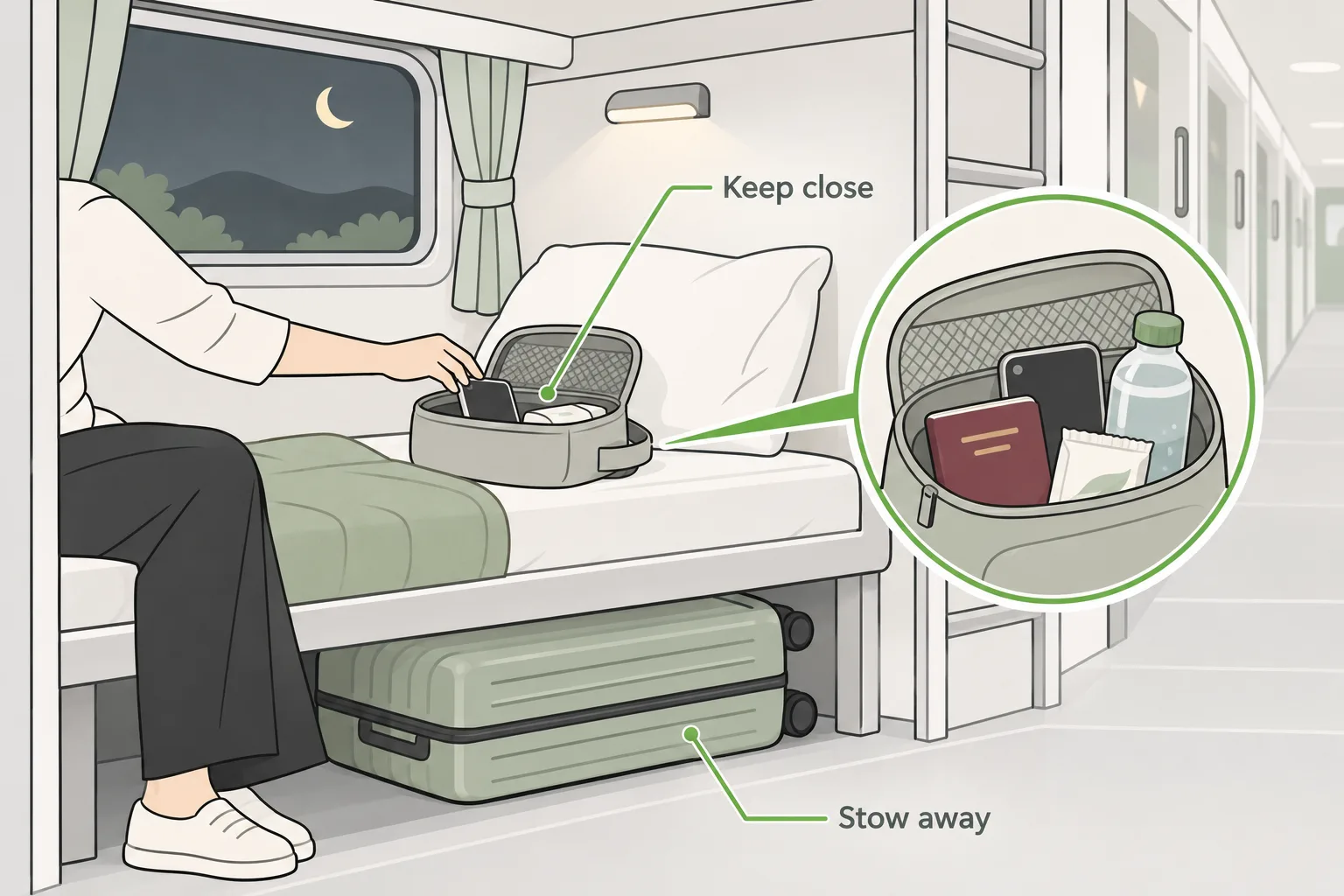
Keep overnight essentials within reach and stow the larger bag where it leaves the aisle clear.
Pack so you can manage your larger bag without blocking the aisle or exits. Follow staff instructions on where it can be stored. Before settling in, locate your coach, berth, toilet and a staff contact point.
Use an eye mask or earplugs if suitable for you, and set an alarm you can notice without disturbing others for long. Other passengers may board or leave while you are sleeping. Follow instructions for hot-water dispensers and avoid carrying uncovered hot drinks through a moving carriage.
Board on the correct calendar date
Ask Buddy ↗Read the departure date at your boarding station. A train leaving shortly after midnight requires you to reach the station on the preceding evening. Arrival on the following morning is a different date again.
Carry the original identity document used in the booking. Allow time for station entry, security and finding the correct gate. Sleeper travel does not remove those checks.
Before sleeping, save your destination station and planned arrival time offline. If unsure when to get ready, ask 请问到站前什么时候需要准备下车? — “When should I get ready before we reach my stop?”
Plan for arriving before your hotel room is ready
Ask Buddy ↗Ask the hotel about early room access or luggage storage before booking the overnight train. Standard check-in arrangements may leave a gap between the train's arrival and access to a room; do not count a saved hotel night without considering that gap.
Keep the arrival morning light. Confirm onward transport, a place to rest and access to breakfast or drinking water. If the train is delayed, update any pickup and avoid treating a separate onward booking as protected automatically.