 ChinaBuddy
How to Plan Your First China Trip: Cities, Nights and Connections
Choose cities, allocate nights and compare travel legs for a first China trip, with realistic example routes and booking checks.
IN THIS GUIDE
For a first China trip, choose a small number of places you genuinely want to experience, then check the journeys between them before booking hotels. Your useful sightseeing time depends on arrival times, station locations and transfers as well as the number of days on your calendar.
Start by confirming your entry eligibility. If you are using visa-free transit, the permitted route and travel areas constrain the itinerary from the beginning.
Choose the trip you want, then the cities
Ask Buddy ↗Write down three experiences that would make the trip worthwhile: imperial history, contemporary urban life, particular foods, landscapes, museums or visiting friends. Choose a main base for each experience rather than collecting famous city names.
| Interest | A possible starting point | Planning question |
|---|---|---|
| Imperial buildings and major museums | Beijing | Can you secure the reservations that matter to you? |
| A large contemporary city and nearby side trips | Shanghai | Would a day trip satisfy you without another hotel move? |
| Historic sites and regional food | Xi'an | Are your priority sites in the city or a separate excursion? |
| Food and a slower city stay | Chengdu | How much time do you want for the city itself versus excursions? |
These are starting points, not rankings. A city fits when its activities and travel connections match your interests, dates and pace. Check seasonal weather, public holidays and accessibility needs for the actual places you choose.

Illustrative route planning: count nights and travel blocks before choosing how many cities to visit.
Count nights and travel blocks
Ask Buddy ↗Write the itinerary as hotel nights, not a list of places under each day number. Your first day may consist mostly of landing, immigration and getting to the hotel. A late departure may create useful time, but only after allowing for luggage and the journey to the airport.
For every move, include hotel checkout, travel to the station or airport, waiting and security, the main journey, onward transport and the next check-in. The advertised train or flight duration covers only part of that block.
An itinerary with a short flight every second day can leave less useful time than a longer stay in two cities. Plan at least one uncommitted block after a demanding arrival or before a flight you cannot miss.
Example routes to adapt
Ask Buddy ↗The following are illustrative allocations, not booked itineraries or guarantees of visa-free eligibility. Nights add up independently of how airlines label overnight flights.
| Time in China | Example allocation | Why it is manageable |
|---|---|---|
| 7 days / 6 nights | Beijing 3 nights + Shanghai 3 nights | Two bases and one intercity move |
| 10 days / 9 nights | Beijing 3 + Xi'an 2 + Shanghai 4 | Three contrasting bases, with two moves to price and schedule |
| 14 days / 13 nights | Beijing 4 + Xi'an 3 + Chengdu 3 + Shanghai 3 | More variety, provided each connection leaves enough time |
Choose the order after comparing actual arrival and departure airports and domestic connections. An open-jaw international ticket—arriving in one city and leaving another—may avoid retracing your route, but compare the full fare and conditions. A return ticket to the same city may still be the better fit.
For a transit-based trip, check the complete international routing and permitted areas against the current rules before treating any example as usable.
Compare trains and flights door to door
Ask Buddy ↗Search the exact stations or airports, not just the city names. Shanghai Hongqiao railway station, Shanghai railway station and Pudong airport are different places. Beijing Capital and Beijing Daxing are different airports.
For each candidate leg, record:
- Total fare for everyone, including baggage and service charges.
- Departure and arrival locations in English and Chinese.
- Time required to reach and leave those locations.
- Whether the arrival allows a straightforward hotel check-in.
- Change and cancellation conditions.
Use China Railway 12306 for railway availability and the airline or booking provider for current flights. A rail connection is attractive when the stations suit your hotels; a flight can be sensible for a long leg. Make the comparison for the actual itinerary.
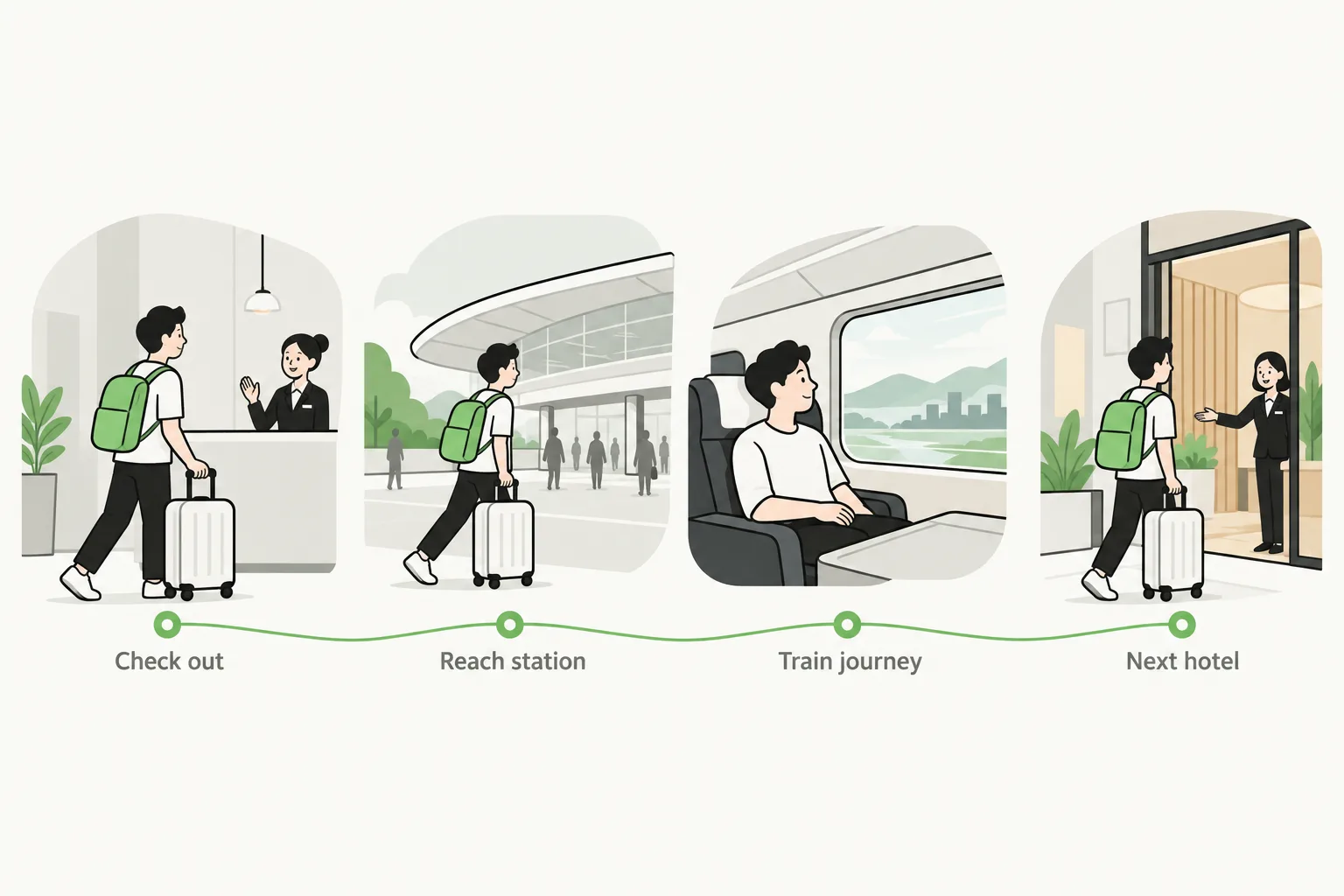
Schematic intercity travel block: hotel checkout → station transfer → train journey → next hotel. The advertised train time covers only one part.
Reserve the important constraints first
Ask Buddy ↗Identify anything with a limited booking window or a fixed date: an international flight, a particular museum, a concert or visiting someone on a specific day. Check the official reservation instructions, then place hotel nights and travel legs around those constraints.
Distinguish a request or advance reservation from a confirmed ticket. Save the issued booking reference and the relevant terms. If you book through an intermediary, know which company will handle changes.
Use cancellable accommodation where the route is still uncertain, after checking the deadline and local time zone. Ask about late arrival if your flight or train reaches the city in the evening.
Turn the route into something you can use offline
Ask Buddy ↗For each move, save the booking, the full departure-place name, the hotel's Chinese name and address, and a fallback transport option. Set up essential apps, payments and connectivity before departure.
ChinaBuddy can help compare options using your dates, hotels and pace. Live fares and availability still need a fresh query, and a suggested journey is not a completed reservation.